The Post-Traumatic Stress Disorder Sourcebook: A Guide to Healing, Recovery, and Growth, Revised and Expanded by Glenn R. Schiraldi
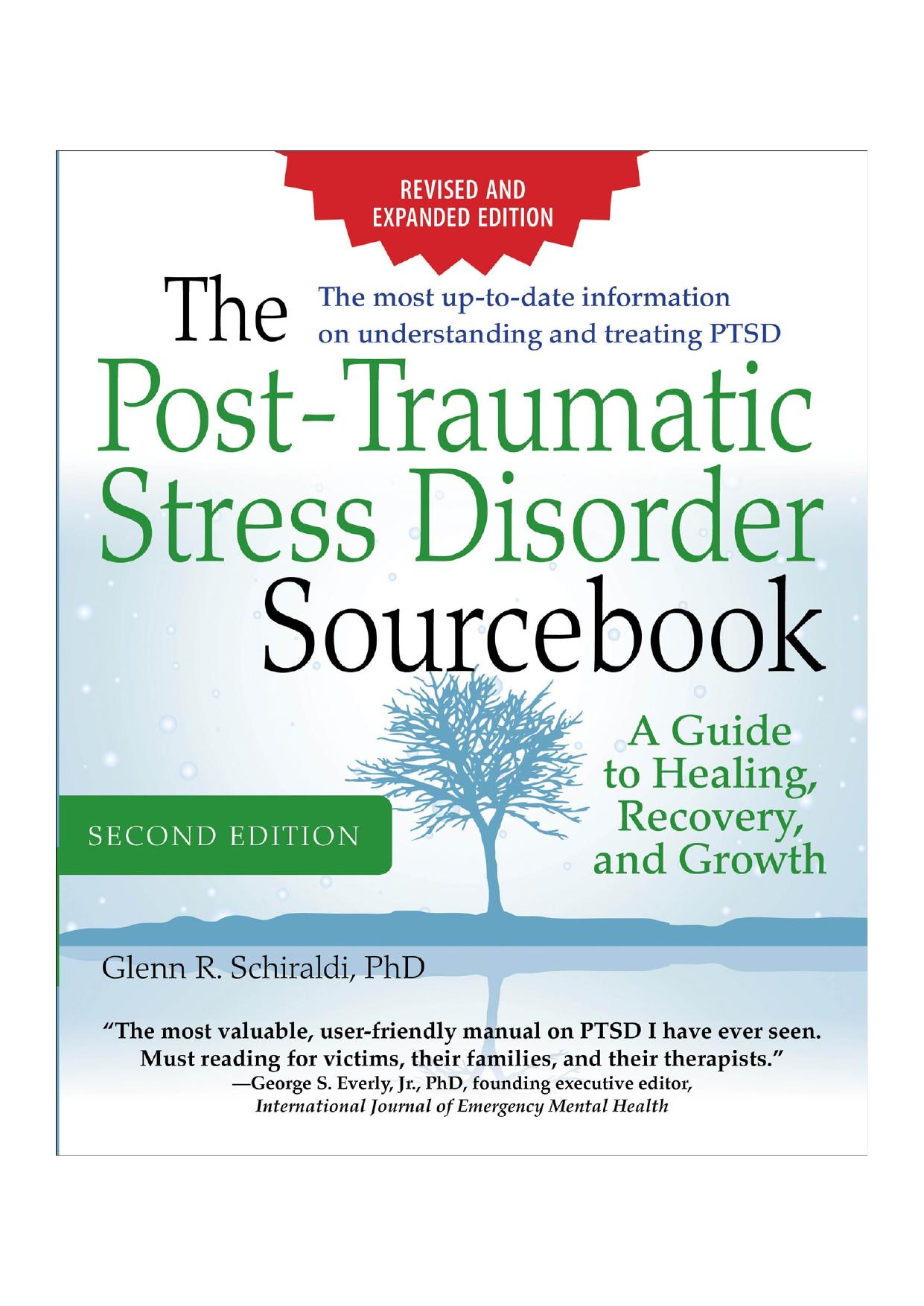
Author:Glenn R. Schiraldi
Language: eng
Format: epub, pdf
Publisher: McGraw-Hill Education
Published: 2016-02-29T16:00:00+00:00
“THIS IS JUST A DREAM”
Imagine that you see yourself at a specific, intense point in the dream carrying out a simple task, such as looking at your hand as it kneads your arm, and saying in the dream, “This is just a dream.” Practice this before you go to sleep to serve as a cue to remind yourself that this is just a dream, should the dream actually recur.3
TURN TOWARD THE NIGHTMARE
Confront the nightmare and find appropriate ways to modify it. Here are some ideas:
• Confront the monster chasing you and ask in a direct and friendly way, “What is it you want—what are you trying to tell me?” One person confronted the monster and discovered that it represented himself and his guilt. He assessed his guilt and made some growth-promoting changes. See if you can make the monster laugh, smile, or get it to dance.
• Change the dream into a story that is not distressing—in any way you wish. For example, see the assailant being caught. See yourself coping well, being rescued, surrounded by castle walls with a protective moat, or flying away with sprouted wings. A firefighter sees burned children “now with God”—healed, playing, and laughing. You might simply visualize yourself saying, “I am safe now, I survived,” “I did my best,” or any other positive cognition. Try to create an ending that does not contain violence, which usually keeps strong distressing emotions at a high level.
• Write out or talk out what you did earlier. (Others can sometimes suggest helpful changes you didn’t think about.)
• Use art to draw the nightmare and then the more positive ending. Consider all the positive choices you have now.4
• For a week, rehearse the new dream in your imagination for about 10 to 15 minutes before going to sleep, followed by a relaxation exercise.
Remember, dreams—like walled-off memories—change as we learn to cope and better process dissociated material. You might dream about positive outcomes. Dreams of the deceased might include assurances that they are now well off or opportunities to say good-bye. As your recovery proceeds, pay attention to the quality of your dreams. King and Sheehan have written5:
Dreams of growth and understanding excite both the survivor and the therapist. In them, the dreamer behaves or feels differently, sees things from a different point of view, attends to some element of the situation that she has ignored in the past, sees new possibilities emerging. The affective tone of the dreams becomes more positive. The dreamer may come to realize for the first time that she did the best she could at the time of the [traumatic event], or that she had no viable options. She may see more clearly the role of significant others, then and now.
Download
The Post-Traumatic Stress Disorder Sourcebook: A Guide to Healing, Recovery, and Growth, Revised and Expanded by Glenn R. Schiraldi.pdf
This site does not store any files on its server. We only index and link to content provided by other sites. Please contact the content providers to delete copyright contents if any and email us, we'll remove relevant links or contents immediately.
Should I Stay or Should I Go? by Ramani Durvasula(7639)
Why We Sleep: Unlocking the Power of Sleep and Dreams by Matthew Walker(6684)
Fear by Osho(4722)
Flow by Mihaly Csikszentmihalyi(4666)
Rising Strong by Brene Brown(4433)
Why We Sleep by Matthew Walker(4420)
The Hacking of the American Mind by Robert H. Lustig(4355)
How to Change Your Mind by Michael Pollan(4338)
Too Much and Not the Mood by Durga Chew-Bose(4320)
Lost Connections by Johann Hari(4161)
He's Just Not That Into You by Greg Behrendt & Liz Tuccillo(3872)
Evolve Your Brain by Joe Dispenza(3651)
The Courage to Be Disliked by Ichiro Kishimi & Fumitake Koga(3469)
Crazy Is My Superpower by A.J. Mendez Brooks(3379)
In Cold Blood by Truman Capote(3365)
Resisting Happiness by Matthew Kelly(3331)
What If This Were Enough? by Heather Havrilesky(3298)
The Book of Human Emotions by Tiffany Watt Smith(3282)
Descartes' Error by Antonio Damasio(3262)
